Sunday, July 29, 2012

Devo: "We Were Punk Scientists"

"Son, you got a panty on your head."
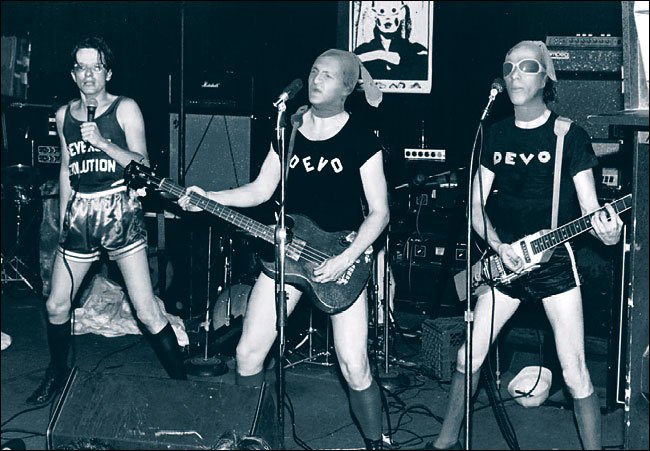
L-R: Mark Mothersbaugh, Jerry Casale, Bob Mothersbaugh

.
Today we revisit an amazing Jerry Casale (pronounced kuh-SAHL-ee) interview shot for a history of rock 'n' roll documentary in 1995. Casale, of course, was one of the big brains behind Devo, Akron, Ohio's beloved new wave/punk institution. And by beloved, I mean mostly hated during their lifetime. It was Devo's own fault, really. They should've known better than to challenge our musical comfort zones with their synthy agitprop and deliberately annoying sensibility. I'm not sure if Devo's ever gonna make it in the Rock 'n' Roll Hall of Fame, but if they do their exhibit should be called, "Fuck You, Devo." I heard that phrase years before I knew punk rock and new wave were things to hate (depending on your perspective, natch).

With the benefit of hindsight, the joke was clearly on mainstream America. Devo weren't just revolutionaries, they were counter-revolutionaries, rejecting the prevailing hippie left-wing's militant self-absorption. If you bristle at this label and find it to be a gross overgeneralization of the era, it's PRECISELY why Devo was invented. They were punks in the best sense of the word and their brilliantly confrontational visual/performance aesthetic lampooned the excesses and hypocrisies of American culture, of which said hippies were part. As Casale notes here with articulate clarity, "What (audiences) wanted was what they'd been getting. They'd been programmed for conformity and Devo was walking in there with original material. It didn't sound like anything, it didn't look like anything that they already liked. And that's just totally unacceptable."

These two clips are from an excellent eight-part series [go to Adios Lounge YouTube playlist]. Actually, it should be nine parts, but Part 6 is blocked by Warners due to brief inclusion of the "That's Good" video. God forbid anyone sees a few snatches of some old video in the background of a long-forgotten interview. It's obviously a blatant copyright violation without any possible educational content. At least that's what this lawyer just told me in between bites of human flesh. Anyway, below the videos are excerpted Casale quotes, including the time at which said quote begins. Enjoy the genius

JERRY CASALE'S ORAL HISTORY OF DEVO - PART 1


0:00
"You know in Ohio in the '70s it was really a period of the extended house of pain. Not the group, the reality of the 'house of pain.' It started with May 4, 1970, where I was a student at Kent State University and I was friends with two of the four students that were shot and killed by the National Guard that day of the protest against the expansion of the Vietnam War into Cambodia by President Nixon, then-President Nixon. And it was an unbelievable experience 'cause it completely changed me from some kind of free love, pot smoking hippie into a very politicized person that had a new agenda and a new, well-founded anger that's carried me through 20 years hence."

1:32
"That experience shifted dimensions for me that probably didn't start to get better until I saw the Diamond Dogs tour by David Bowie in 1974 and realized that maybe I could do something creative about the way I felt, which became Devo."

2:00
"I was teaching drawing and design at Kent State University and I met Mark Mothersbaugh, my partner-in-crime in Devo. He was an artist and we were both attracted to the same kind of, what we called then 'the high' and 'the low.' To combine the lofty ideas of art history and literature with the crassest, most ridiculous, most inane kind of expressions of pop culture."

1925 pamphlet that introduced jocko homos and de-evolution to Jerry Casale and Mark Mothersbaugh

4:18
"I was playing in a blues band (15-60-75 aka The Numbers Band) and (Mothersbaugh) was playing in a band that was doing hard rock covers and we decided to stop doing that. We thought it was ridiculous to not take the implications of all this visual art and apply it to our music. What would this art that we'd been doing -- that we called 'de-evolution,' and we were doing 'art deveaux' -- what would happen if there was music? What would that be like?"

5:10
"We started taping our music on a four-track. We spent about three years doing that (roughly 1973-76) and then decided we would play out in public. I pretended to be the manager and I would lie to these club owners and tell them we could do covers of Bad Company and the Captain & Tennille. We'd get booked and get about three songs into the set and they'd throw us out. Once we got paid to leave, which was nice because we usually didn't get paid."

6:00
"What (audiences) wanted was what they'd been getting. They'd been programmed for conformity and Devo was walking in there with original material. It didn't sound like anything, it didn't look like anything that they already liked. And that's just totally unacceptable. It's unacceptable at any time in history, it had nothing to do with the '70s. It's just always unacceptable and we knew that."

7:09
"We took our instruments out which had all been modified and customized and run through all the devices of the time. Mu-trons, wah-wah pedals, whatever we could find. Mark had a Moog synthesizer, a Minimoog, he was the only guy in Ohio that had one, I think. We bought a second one and dismantled it and his brother (Jim Mothersbaugh), who was the drummer, created a homemade set of electronic drums. Devo really looked like some agitprop group that was playing this industrial noise that had structure and progression to it. In a much more Little Rascals manner than Nine Inch Nails does today."

JERRY CASALE'S ORAL HISTORY OF DEVO - PART 2


:21
"Mark and I both liked very much early Roxy Music with Bryan Ferry and Brian Eno together in the group. And David Bowie. I mentioned really it was the Diamond Dogs concert in 1974 by David Bowie that gave me hope that the ideas that Devo had could be put together in some formal way and we could get a voice in the marketplace. We could be seen and heard. But, in addition to that music we were into bad TV soundtracks and Italian movie soundtracks, and certainly Nino Rota, Ennio Morricone, things like that."

1:46
"We didn't like being called punk because we saw the punks as only historical punks. There was nothing truly punky about 'em because they were looking back, taking all their ideas about how they looked, the sound of the music, the progressions, and the kind of anger, they were taking it from the '60s. We just found that kind of simple-minded and historical. We thought we were the true punks 'cause we were hated by everybody. We were punk scientists. We were doing something that looked wrong, sounded wrong, and we talked about things that no one was talking about."

3:14
We decided that the only way we could crack the music business was to completely put the whole vision together. We were thinking back then about the marriage of visuals and music and theatrics and the philosophy as an entire package to kind of create a Devo universe.

Devo's first single
.
3:53
(In 1976) we picked "Mongoloid" and "Jocko Homo," two of our first songs, and went to Queen City Records in Cincinnati, where we could get a cheap deal and where a lot of the R&B in the area had been pressed up. For $2000, that Mark and I made by silkscreening designs and selling T-shirts, we made our own record, our own 45, on Booji (pronounced boogie) Boy Records, our own record label, after our character of Booji Boy, the infant as old as the mountains, but as yet unborn. A kind of Yoda character."

4:27
"We passed (our 45) around to every record store we could find. I posed as our manager, wrote letters of introduction, and sent it along with our first homemade video, which was The Truth About De-Evolution. We'd filmed it the same year on 16mm film with more of that T-shirt money. I sent it around to all the record companies and I sent it to Saturday Night Live, where Dan Ackroyd promptly threw it in the wastebasket. Nothing happened whatsoever, nothing. Nobody responded, nobody called back. Except then, the film was part of the (1976) Ann Arbor Film Festival, and it won an award for Best Film Short because people either were horrified by it or laughed at it. Which is the absolute perfect response that we wanted because we were dealing with that fine line of really being smart, but appearing stupid."

DEVO - JOCKO HOMO (1976 VERSION)


In October 1977, Devo would re-record "Jocko Homo" with Brian Eno (and an uncredited David Bowie) for their debut album, Q: Are We Not Men? A: We Are Devo! However, this is the starker, more minimalist Booji Boy version and this video is excerpted from the aforementioned Truth About De-Evolution short film. Aggravating and unsettling both musically and visually, "Jocko Homo" was Devo's mission statement and their meta-critique of humanity. Get yer learn on, pinheads.

They tell us that
We lost our tails
Evolving up
From little snails
I say it's all
Just wind in sails
Are we not men?
We are Devo
Are we not men?
D-E-V-O

Wednesday, July 18, 2012

Leaning On The Everlasting Arms

Safe and secure from all alarms ... even Robert Mitchum

.
"Leaning On The Everlasting Arms" is a hymn written in the late 19th century, not markedly different in structure or tone from a thousand other hymns and spirituals of the era. Composed by Anthony Showalter and Elisha Hoffman, "Leaning" was inspired by Deuteronomy 33:27, "The eternal God is thy refuge and underneath are the everlasting arms." If you're gonna write a hymn, that's probably a good place to start. However, the song occupies a unique place in American culture, not because of its inherent musicality, but because it's been a powerful narrative device in three separate films, each of which reflects the American experience.

1943 was one of the shittier years in US history. Knee deep in the war effort, we ate dirt for breakfast, weeds for dinner, and contented ourselves with Frank Sinatra, Betty Grable, and World War II movies. One of those movies was The Human Comedy, a homefront drama starring Mickey Rooney that filled you full of homilies and song, gave you a small measure of hope, and is palatable in 2012 for maybe 10 minutes. Pure, uncut sentimentality, not much going on in the plot, it was clearly created to distract 1943 for two hours, 2012 sensibilities can eat shit. Narrative limitations notwithstanding, one of the better scenes was when a train full of GIs bound for the Pacific began singing an old hymn.


The Human Comedy, 1943
Director: Clarence Brown

This is reminiscent of the scene in Casablanca were Victor Lazslo leads the band through "La Marseillaise." Obviously, with the one character here breaking the fourth wall and looking directly into the camera, the expectation was to lead the movie audience in the singalong. Remember, it was 1943 and Americans didn't need any fucking gray area or moral quandary. There would be plenty of time for that after the war. Our movies contained rousing anthems because that's what we needed. Life was black and white and at stake was Allied vs Axis, good vs evil, love vs hate, and there were no guarantees that the good guys would win.

The difference between the two songs is how they relate to identity. "La Marseillaise" is the French national anthem, so for Americans watching Casablanca it's obviously meant to convey sympathy for a war ally. "Leaning On The Everlasting Arms" works on a different level. Sure, it's an American hymn in a war movie, so it can't help but be political to some degree. But, a hymn is an expression of spirituality and being connected to "something we all know and used to sing as kids." For Americans about to enter a war they might not win -- and even if they win, might not come back alive -- it took more than "God Bless America" and "Yankee Doodle Dandy" to give us strength. If there were no atheists in WWII foxholes, it's probably because they were singing this song.

Spoiler Alert: The good guys won World War II. And with Allied victory came postwar surplus, as well as its twisted American counterpart, postwar malaise. In 1955, one movie reflected this creepy duality through its own appropriation of "Leaning On The Everlasting Arms," The Night Of The Hunter. As it turns out, there's a direct connection between Hunter and The Human Comedy: Robert Mitchum, who appeared uncredited in Clarence Brown's wartime drama.


That's Mitchum to the far left.

Please note two things. 1) The girl in the dark dress is Donna Reed, three years before she co-starred in It's A Wonderful Life, and 2) It's Mitchum who begins singing the Roy Rogers song, "Git Along Little Dogies," at the end of this scene. This would normally be a forgettable throwaway element, were it not for his singing twelve years hence.

Oh, and it's some singing ...


Robert Mitchum and Lillian Gish
The Night Of The Hunter, 1955
Director: Charles Laughton

The Night Of The Hunter is a brilliant American phantasmagoria, despite the fact Laughton was British, and his film was visually influenced by German expressionism. If WWII movies conveyed the simplistic idea that America and democracy were good and Hitler and fascism were bad, the best postwar movies revealed that evil is not only here in America, it may be superficially indistinguishable from good. In fact, the scariest possibility of all is that good AND evil -- or love and hate, if you prefer -- are inside all of us. To wit:

"Those fingers, dear hearts, is always a-warring and a-tugging, one agin t'other."

Laughton's genius was recontextualizing "Leaning On The Everlasting Arms" to reflect this duality. For Mitchum's character, "Reverend" Harry Powell, the hymn was a sociopath's siren song, used to prey on (pray on?) the gullibility and childish naivete of adults. As the titular hunter, he is hate personified. Lillian Gish's character, Rachel Cooper reclaims "Leaning" with the fierce determination of true faith. She is love personified. As she declares earlier in the movie, she is "a strong tree with branches for many birds." Oh, and one of her branches is a shotgun, so there's that.

If "Leaning" is "something we all know and used to sing as kids," then it stands to reason that some kids grow into good adults, others grow into bad adults, and there's probably more overlap than we care to admit. Hymns belong to everybody. In fact, sometimes hymns belong to kids.

What have I to dread? What have I to fear?

What music should accompany a 14-year-old girl bent on avenging her father's murder in the Old West? "I thought that hymns, or music that sounded like hymns, would remind you that what's driving the whole story is a biblical sense of righteousness," says composer Carter Burwell of "True Grit." (Variety, Dec 15, 2010)

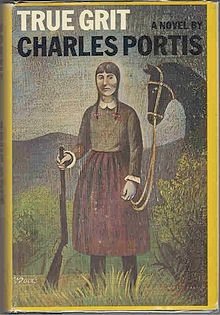
If The Night Of The Hunter reflected the America of 1955, the same could be said of True Grit in 2010. For one thing, what could be more 21st century than recycling a previously successful idea? Thankfully, it was the Coen Brothers doing the recycling, so what could've been a quick and dirty cash grab was instead a heartfelt reprisal of a great story. In fact, I argue that True Grit 2010 was less a remake of True Grit 1969, than it was the first proper adaptation of Charles Portis' 1968 novel.

The original True Grit was an homage to John Wayne, Portis' novel was merely a convenient reference point. The Coens adhere to the book's narrative, focusing on Mattie Ross, the tenacious, 14-year-old girl whose father is killed. Like any good daughter, she invoked Old Testament-style vengeance when playing ball didn't work. Unfortunately, Mattie learned the hard way about going Biblical. She lost her arm and killed her horse and her father wasn't any less dead. When she says, "You pay for everything in this world. There is nothing free, except the grace of God," it's with the understanding that the grace was simply not dying. Also, with the Coens not being dummies, I can't help but feel the song title is an ironic commentary on Mattie's condition. Not mocking nor rebuking, so much as reminding her that "Vengeance is mine; I will repay, saith the Lord." (Romans 12:19)

FYI: This video is a bit louder than the others. Prepare accordingly.


Iris DeMent, "Leaning On The Everlasting Arms"
True Grit, 2010
Directors: Joel & Ethan Coen

Of the four movies mentioned thus far, three of them share a unique characteristic. Both True Grits and The Night Of The Hunter are all homages to an earlier era of Hollywood. If True Grit 1969 was an homage to John Wayne, True Grit 2010 was an homage to the western itself. In fact, you can make a strong argument that True Grit 1969 was the first meta-western and every western since has also been a tribute to the genre. Meanwhile, The Night Of The Hunter was Charles Laughton's homage to D.W. Griffith and the silent era of Hollywood, including actual Lillian Gish, star of Griffith classics, The Birth Of A Nation and Intolerance.

What a blessedness, what a peace is mine

I now leave you with bonus "Leaning."  Two weeks ago today, Andy Griffith died of a heart attack at his home in North Carolina. For those of you keeping score, that's three prominent NC musicians to die in less than 100 days: Earl Scruggs (March 28), Doc Watson (May 29), and Griffith (July 3). Granted, these fellas were all in their mid-to-late 80s, but we might wanna keep an eye on the members of Superchunk just in case.

This clip comes from either a 1963-64 episode of The Andy Griffith Show featuring Andy and The Darlings singing a verse and the refrain of "Leaning On The Everlasting Arms." The Darlings were actually The Dillards, a pioneering bluegrass band in early '60s Los Angeles, featuring Rodney Dillard on guitar, dobro, and vocals and Doug Dillard on banjo and vocals. Sadly, Doug died this past May 16 from complications due to a collapsed lung, preceding Andy in death by only 49 days. It is to their memory that this song is dedicated.


Doug is between Rodney on guitar and Denver Pyle on handlebar 'stache

What have I to dread, what have I to fear
Leaning on the everlasting arms
I have blessed peace with my Lord so near
Leaning on the everlasting arms

Leaning, leaning, safe and secure from all alarms
Leaning, leaning, leaning on the everlasting arms

Saturday, July 7, 2012

6


A song for my beautiful daughter, Leilani Davis, on her 6th birthday. Wish I could be there with you, but where you live isn't safe for good daddies. Just know that I think about you ALL the time and love you very much.

PS - Don't forget to hydrate. It gets hot in Mordor.

Alabama Shakes - I Ain't The Same
From Boys & Girls
Amazon

Well, I've been going through the motions
Wonder if anyone can see
That I've been looking for something
Have you been looking for me?

I ain't the same no more
In fact, I have changed from before
No, you ain't gonna find me
Oh no, 'cause I'm not who I used to be

I used to be a little girl
Just a-smiling, feeling free
I wasn't worried about nobody
Nobody worried about me

But, I ain't the same no more
You'll find I have changed from before
No, you ain't gonna find me
'Cause I ain't who I used to be

I said I'd never grow old
I can't remember how it used to be
I found myself without the power
I found myself without the glory

Listen! I ain't the same no more
You'll find I have changed from before
You ain't gonna find me
Oh no, 'cause I ain't who I used to be
Oh no, no I ain't who I used to be
Oh no...

Wednesday, July 4, 2012

Bobby Jealousy: Dirtpop, Bliss and Desperation

L-R: Seth Gibbs, Sabrina Ellis, Mark Stoney
Photo: Kelly West, Austin American-Statesman
.
First thing to establish is that Bobby Jealousy isn't a him, it's a they. They're a band from Austin, TX, and they've released my favorite album so far in 2012, A Little Death. The title is a slight variation on the phrase, la petite mort, which is existential Française for orgasm because of course it is. Actually, the orgasm is a perfect reference for Bobby J because the album is about fucking and getting fucked as much as anything ("Fucked with you/Fucked you, then I fought with you"), not to mention the endorphin rush of being in blissful, desperate love ("What would I do without you/To hold me when it hurts so bad/Don't ever let me go). Or, maybe I just think this way because A Little Death has been sexing the shit out of my earballs ever since Ducktaper sent it to me after SXSW.

Bobby Jealousy combines '50s music, Dollsy glam, soul, punk, and probably a dozen other things into a joyous pop tornado. A Little Death is sprawling and epic, like Wilco circa Being There crossed with Queen. Yes, THAT Queen. This may not be an accident. As lead singer, Sabrina Ellis, told Austin360, "I grew up listening to Queen. I wanted to be Freddie Mercury. I would dress up in these one-piece unitards and put on a fake mustache and sing my heart out." If reports of their live shows are any indication, this wasn't a passing phase. Speaking of Freddie, I think Bobby J's song, "Rainbow," should be appropriated by gay rights advocates. They get a new anthem, Bobby J gets mad royalties, everyone wins.

Bobby Jealousy - Rainbow + Band Intros


Recorded at Superpop Studios, Late 2011
Engineered/Mixed/Mastered by Seth Gibbs
Video produced for Hardly Sound by Randy Reynolds & Chris Kim


In describing Bobby Jealousy, the phrase I hear most is "dirtpop." I love that. I think it describes the band perfectly and I'm not totally sure why. Maybe it's the vocal harmonies, the way they fit together perfectly, but not in the lush, tightly blended, and reverby way so prevalent in the last 6-7 years (think My Morning Band Of Foxes). The voices on A Little Death have space to move around, as does the music, the sum of the parts blending casually, yet with purpose, and I think this is a credit to the one-woman, two-man songwriting and production operation that is Bobby J.

Sabrina Ellis is the group's thrift-store Freddie Mercury, an f-bombing force of nature from whom your eyes (and ears) will not want to move. I find it interesting that in the past calendar year, my new favorite singers have invariably been badass females: Lydia Loveless, Brittany Howard of Alabama Shakes, and Carrie Brownstein and Mary Timony of Wild Flag (neither "new," but in a new aggregation). Ellis holds her own with any of them. Aside from Mercury, the singer she really reminds me of is PJ Harvey, from back in the old stripped-down trio days (Dry, Rid Of Me). Sabrina is actually responsible for my second favorite record so far in 2012, Fight, by her other band, A Giant Dog. They're noisier and more garage punk than Bobby Jealousy, but Ellis' glamboyance is common ground in both. Fight is a must-hear and I'll probably write about it (and them) later.


Ellis' main foil in Bobby J is husband, Seth Gibbs. You may remember him from such Adios Lounge appearances as Rebel Land, Alabam: The Dexateens & Archibalds (Seth was bassist in The Archibalds) and SX Sam's Town Point 2011 (Seth appeared with Brother Machine). In addition to singing and songwriting, Gibbs is the band's bassist, but he'll play whatever damn instrument he feels like mastering that day. I'm pretty sure he's one of those fancy musical geniuses. As a bassist, he has a funky sensibility, yet will throw in gorgeous countermelodies. If those contributions weren't enough, Seth is also the brains behind Superpop Records, the recording studio where A Little Death was produced, mixed, and mastered.

The third component to the Bobby J sound is singer/guitarist, Mark Stoney. He actually was a pop star in Britain, but within the last decade, not in the 1970s. His experience in the British music industry, and as a producer in his own right, is an interesting facet of Bobby J. He says of his background, "Where I was from in Sheffield ... it was a very close community of musicians, the Arctic Monkeys and Pulp, even back to the Human League and Cabaret Voltaire. That was sort of my stomping ground where I cut my teeth." (Austin360, same article from which Sabrina is quoted above). I'm not a real big Britpop guy, but I can't deny that whatever Stoney's bringing to the table totally works as an ideal counterweight in Bobby Jealousy.

Bobby Jealousy - Take You On


Recorded at Superpop Studios, Late 2011
Engineered/Mixed/Mastered by Seth Gibbs
Video produced for Hardly Sound by Randy Reynolds & Chris Kim


And here's where all those influences come together in a bitches brew of perfect pop. "Take You On" evokes two separate strains of '50s music -- American doo wop and British skiffle -- and the result is pure gold. If you say you like pop music and don't like this, you either don't understand what "pop" means or are suffering from heatstroke. Maybe both. It's hot out there.

"Take You On" also has one of my favorite choruses in recent memory:

"Never admit that I was wrong
Can't be defeated if I quit
Responsibility, commitment, all that shit
I'll never be alone again."


Bobby Jealousy - Flamethrower
A Little Death
2012
Bandcamp

The leadoff track from A Little Death sounds a bit like Neko Case, and a lot like mid-period Flaming Lips (maybe that's where the flame reference comes from?). Gibbs' bass is a particular highlight, giving the song a fat, funky pocket, while also echoing the vocal melodies and synth line(s) riding on top. The appeal isn't that complicated. It's infectious and anthemic and yet another example of their glorious dirtpop.

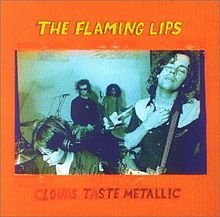
Flaming Lips - Bad Days (Excerpt)
Clouds Taste Metallic
1995
Amazon

"We make the music into this sort of capsulized thing, something you can imagine the Bee Gees doing. It's a little like Christmas music. We use the atmosphere of what the song is about to get the point across."
--Wayne Coyne, Rolling Stone, March 9, 1995


When I said "Flamethrower" reminded me of the Lips, this is not only the song I had in mind, this is the specific section. 1990-95 is my favorite era of the Flaming Lips, pre-auto-tune and before they became "serious" and "significant." Not that it's bad, by any stretch of the imagination. But, gimme everything between In A Priest Driven Ambulance and Clouds Taste Metallic, with the latter album being their high water mark. That era is the perfect blend of experimental noise rock and adventurous pop, with second guitarist, Ronald Jones, then-drummer Steven Drodz, and producer, Dave Fridmann, seemingly equal partners with original members, bassist, Michael Ivins, and gadabout frontman, Wayne Coyne.

Cock Of The Walk

Bobby Jealousy recently completed their first tour, hitting the midwest and east coast. If recent Facebook rumblings are to be believed, they are scheduled to hit the west coast sometime in the next month or so. If you have a chance to see them, by all means go. If nothing else, get thee to Bandcamp. A Little Death is the perfect cure for your lifeless music collection.

Buy A Little Death on Bandcamp
$6 CD+download, $7 download, $15 fancy CD

Bobby Jealousy on Facebook

Bobby Jealousy on Twitter

Come on baby, let's go home
Let's watch the end begin.