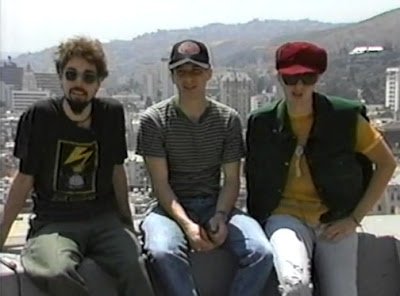
| Mario Caldato, Jr chillin', one might say like Bob Dylan |
In my previous entry, Riddle Me This, My Brother: Deconstructing "Shadrach," I revisited Paul’s Boutique, and for the millionth time marveled at the Beastie Boys and Dust Brothers, who then included Matt Dike. However, Paul’s was a seven-man operation and like a dumbass, I overlooked producer, engineer, mixer, soundman, multi-instrumentalist, electronics whiz, security guard impersonator, and all-around fix-it man, Mario Caldato, Jr.
Caldato is credited as engineer on Paul’s Boutique, but that's kind of a misnomer. The album is almost entirely samples, so it wasn’t like he was miking drums, adjusting amps, and setting levels which are typical engineer tasks, and ironically, what he'd come to do on Check Your Head and Ill Communication, where he'd serve as producer. Outside of "Looking Down The Barrel Of A Gun," there was no band on Paul's, and even on that it was only Ad-Rock's guitar and MCA's bass. In a way, Caldato’s job was more akin to film editing than it was traditional music engineering.
“Basically, we would find a groove, and we would loop it, and then we would print that to tape, and we would just go for five minutes on one track of the tape. And then we would find another loop, and we would spend hours getting that second loop to sync up with the first loop, and then once we had it in sync, we would print that for five minutes on another track. And we would just load up the tape like that.
“And once we had filled up the tape with loops, we would go in, and Mario had this early, early mixing board that had this very primitive form of automation. It was pretty complex, but if you knew which tracks you wanted playing at any given time, you typed the track numbers into this little Commodore computer hooked up to the mixing board. And each time you wanted a new track to come in, you’d have to type it in manually. It was just painful. It took so long. And there was so much trial and error … there was no visual interface (!!!) to show you what was going on. That was the main difficulty we faced.”
--Mike Simpson to Dan LeRoy, Paul’s Boutique 33 1/3 book, pp. 36-37
What kind of MacGyver genius do you have to be to hotwire a Commodore for ANY task in 1989, let alone in creating one of the greatest albums ever??? And without a screen to look at?!?! Amazing. “Mario Caldato, many insist, was the unsung hero of the team, a tireless worker who slaved to translate brilliant concepts into great records” (LeRoy, p. 20). So, to the man they call the Mario, I offer my sincere apologies for not previously acknowledging your ample contributions to Paul’s Boutique.
In fact, the story of Caldato entering the Beasties’ orbit includes one very significant, Adios Lounge-worthy twist. Let us go back three years to August 1986, three months before Licensed To Ill was released. The Beastie Boys spent that summer opening for Run-DMC, who were touring behind their monster album, Raising Hell. On one of two Saturdays, August 9 or August 16 - and I’m almost positive it’s the latter - the Beasties were scheduled to play a hip, underground LA club called Power Tools. Most accounts say this appearance occurred on August 9, but I have my doubts about that. The Raising Hell tour was scheduled for Long Beach Arena on Sunday, August 17 and the Hollywood Palladium on Monday, August 18. Why would there be a secret show a week before the groups hit town? No, August 16 is the only date that makes sense.
UPDATE (6/26): Thanks to an anonymous tipster, I received this flyer in my Adios Lounge inbox. I was assured that not only is it authentic, it actually comes from the collection of one the principals in this story. Of course, the main detail worth noting is the date: August 9. It may not make sense on paper, but if that's when the show was, then that's when it was.
| The Paul's Boutique Studio Army L-R: Matt Dike + horns, Adam Yauch, Mike Simpson, John King (obscured), Michael Diamond, Adam Horovitz, Mario Caldato, Jr. Photo: Ricky Powell |
UPDATE (6/26): Thanks to an anonymous tipster, I received this flyer in my Adios Lounge inbox. I was assured that not only is it authentic, it actually comes from the collection of one the principals in this story. Of course, the main detail worth noting is the date: August 9. It may not make sense on paper, but if that's when the show was, then that's when it was.
| FRONT OF FLYER |
| BACK OF FLYER |
Power Tools was started by (Matt) Dike and Interview photographer, Brad Branson, “as a small intimate gathering,” recalls Pam Turbov, an A&R representative at Columbia Records who would later become an executive at Delicious Vinyl and manage several artists. “It was a pretty eclectic crowd.”
The club began at Branson’s loft on Crenshaw Avenue, with Dike, Branson, Turbov, and model Kathy Yeung as hosts. But, when Branson left California for Europe soon afterward, Dike and (Jon) Sidel decided to move the party to a bigger space downtown. Headquartered in the old Park Plaza Hotel, Power Tools began drawing 2,000 patrons a night. And in the summer of 1986, it hosted an accidentally momentous show which brought together most of the players responsible for Paul’s Boutique.
“It was so intense and so crazy. The energy was like a rock show,” remembers Turbov of the pre-concert atmosphere. “There hadn’t been that before on a hip hop level.” An impressed Run-DMC offered to perform their current single, “My Adidas,” which Sidel wistfully says “would have been the ultimate for us.”
It never happened. The Beastie Boys’ brief set, based around the songs “Hold It Now, Hit It” and “The New Style,” ended prematurely with a blown PA. Sidel had already pleaded with Dike, who he says was “cheap as shit,” about upgrading the club’s equipment, powered only by a home stereo amplifier. Now they would have no choice. And as the club began to empty, an angry patron came to bend Sidel’s ear about the failure.
--Dan LeRoy, Paul’s Boutique 33 1/3 book, pp. 12-13
In March 2001, Caldato was interviewed by TapeOp, a magazine dedicated to music recording. When asked how he initially got involved with the Beastie Boys, he admitted that he wasn't just at Power Tools that hot August night, he was the angry patron.
I was there one night and the Beastie Boys were coming to play. They didn’t have an album out, they just had a single, I think it was “Slow And Low”. So, these guys were up on the stage ready to perform. They had three mics and a DJ setup and were testin' the mics - one-two, one-two. DJ Hurricane was testin' out the turntables and cueing up the first record - chukka-chukka-chukka-bowm. When he hit the first note, the 808 bass sound, the whole sound system shut-off! So (the Beastie Boys) said, “Fuck this!” threw their mics down and walked off the stage.
It really sucked cause 1500 people were there. I was like, “Damn, this PA is bullshit.” It was four speakers and a 200-watt stereo power amp, you know, like a home stereo amp. It just collapsed. The setup sucked, the speakers were on the ground [instead of raised up]. I was so mad. I had to find out who runs this place, who owns this club. I found the owner and said, this is embarrassing, you know your sound system just doesn't work. He said if I had the equipment I could come back next week with it. So, I got some wires and some amps, I raised the speakers up. The owner was so impressed, I got the gig."
--Interview with Mario Caldato, Jr. by Darron Burke (PDF), TapeOp, January 2002, pp. 4-5
Caldato addressed this same Power Tools gig in the second issue of Grand Royal, the Beastie Boys’ publication that was, well, the Paul’s Boutique of magazines in the mid-‘90s. While the debut Grand Royal (with the Bruce Lee/Enter The Dragon cover) fetches the highest prices on eBay, the follow-up is probably the most fully realized issue of the six published.
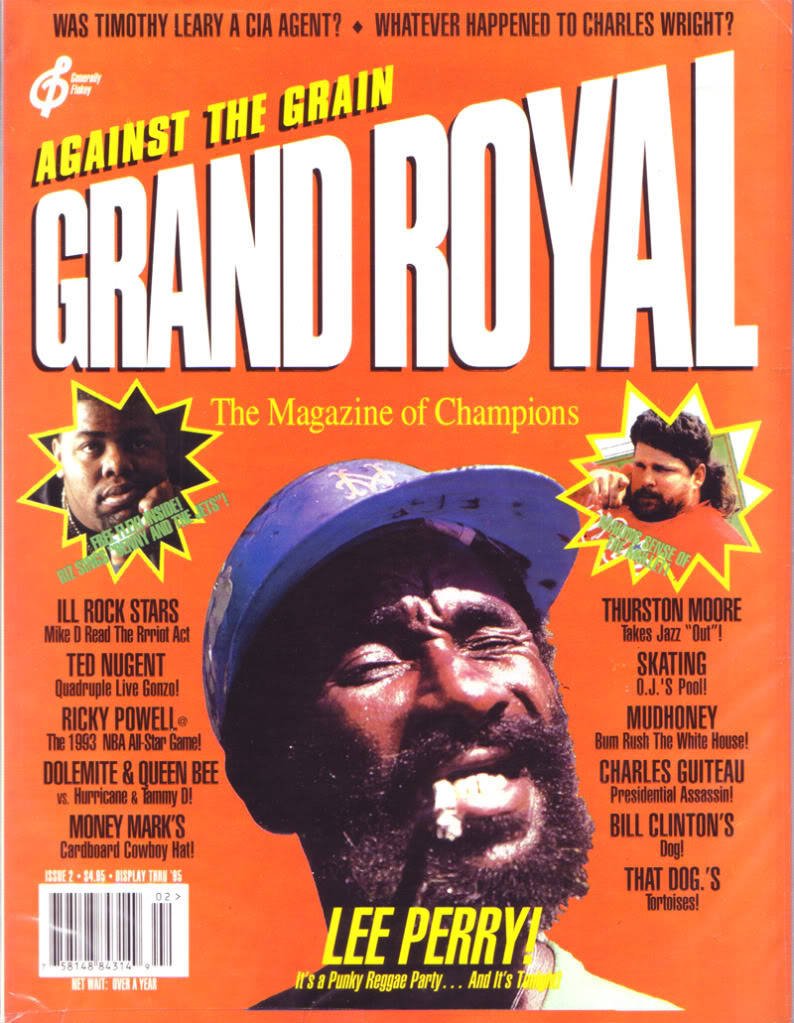 Grand Royal 2 came out in the summer of 1995 and features a 24-page Lee Perry primer, the history of the mullet (the first large-scale examination of that awful hairstyle), GR editor Bob Mack baiting Ted Nugent, Ricky Powell's awkward interactions at the 1994 NBA All-Star Game, Matt Lukin of Mudhoney eating pot before visiting the White House, and in retrospect, maybe the most insider moment in the 'zine’s run, a four-page interview with Mario Caldato, Jr. conducted by a far less contentious Mack.
THEY ALWAYS SAY THAT NUTHIN'S PERFECT
And now for the unique twist. Unlike the interview from TapeOp, the Grand Royal version adds an important detail about the Power Tools performance, otherwise lacking in every other account. And that detail just happens to be one of the patron saints of The Adios Lounge.
THEY ALWAYS SAY THAT NUTHIN'S PERFECT
And now for the unique twist. Unlike the interview from TapeOp, the Grand Royal version adds an important detail about the Power Tools performance, otherwise lacking in every other account. And that detail just happens to be one of the patron saints of The Adios Lounge.
How’d you hook up with the Boys?
I was going to this club called Power Tools and it was the only place that had anything original happening.
Who was running it?
Matt Dike was the DJ (and partner). Jon Sidel and Sean Macpherson were also partners. I was going down there and one night everyone was saying, "Oh, the Beastie Boys are gonna be playing." This is before their first album came out, but they had a couple singles and the vibe was happening.
Were they squirrely?
Very New York, y'know? Mackin' in their own way. They were gonna try to do a song. They had a real small system, like a disco system, and it was barely loud enough to cover the room. Bob Forrest of Thelonious Monster was doing sound. So, they tried to check the mics and they were just barely working. They started to play the record, but as soon as the first big "boom" came on, the whole shit cut off. It just wasn't gonna work. The guys could tell and were like, "Fuck this!" So, they just threw their mics. People in the audience were really buggin'. Then Bob Forrest goes up to the mics and says, "These mics work, the problem is with your rap!" Anyways, they were just talking shit, being ill, like they were known to be back in the day.
--Interview with Mario Caldato, Jr. by Bob Mack, Grand Royal, 1995, p. 104
That the Beastie Boys, Matt Dike, and Mario Caldato, Jr. were at the same LA club in August 1986 makes sense. If anything, it seems like destiny. Dike and Caldato began working together at Power Tools, then at Delicious Vinyl, and ultimately, on Paul’s Boutique. However, Bob Forrest in this context is a straight up WTF. And actually, I forgot I knew this. I’ve had this issue of Grand Royal since the day it came out in mid-1995 and I remember being astounded at this Forresty factoid. I wasn’t on bulletin boards or newsgroups back in the steam engine internet days of 1995, otherwise Thelonious Monster traffic would’ve spiked that day. At least until I got kicked off my stupid dialup connection.
Bob is now semi-famous as the drug dependency counselor (with the hat) on Celebrity Rehab and the subject of Keirda Bahruth’s documentary, Bob And The Monster. In 1986, he was semi-famous (in Los Angeles) as both scenester and lead singer of Thelonious Monster, whose debut album I should note also came out in 1986. Obviously, Baby, You're Bummin' My Life Out In A Supreme Fashion was a blip on the cultural radar compared to Licensed To Ill, but in the special confines of the Adios Lounge, the Monster and the Beasties more or less carry equal weight. (Incidentally, both bands sound like homages to Maurice Sendak, author of Where The Wild Things Are, who passed away four days after Yauch.)
In an interesting sub-twist, Bob recently discussed this fateful night on his awesome internet radio show, All Up In The Interweb. It was the first show following Yauch’s death, so Bob played “Sabotage,” and then followed up with both story and song. Yes, you are about to be privy to a document long since thought lost. Here is the Beastie Boys’ aborted performance from Power Tools, with Bob Forrest on preamble and postamble.
FYI, this sounds like shit because a) It sounded like shit at the time and b) This is probably a 3rd or 4th generation cassette dub. But, it exists, so be thankful.
Bob Forrest + The Beastie Boys
Power Tools, Los Angeles
August 16, 1986
Excerpt from the May 9 broadcast of All Up In The Interweb
Alcohol + frustration + public embarrassment has been known to lead to fisticuffs. Oh well, it was 26 years ago. Bob brings up a valid point, though. When was he going to have experience running sound for a rap show? That’s truly a comical image. I mean, I know it sucked in the moment, but what did Dike expect to happen? He was only yelling at Bob because he could, shit rolleth downhill and whatnot. Of course, no shitty sound, means no Mario Caldato, Jr., and extrapolating from there is a hideous alternate reality from which there’s no escape. So, let’s just admit that everything worked out the way it was supposed to.
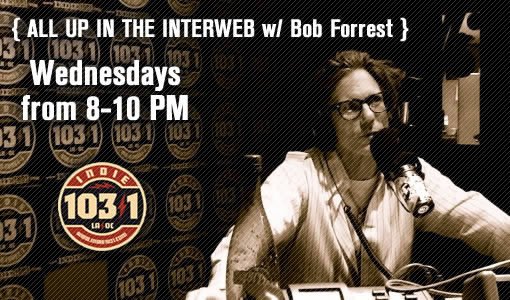
On a related note, y'all really should check out Bob’s show, All Up In The Interweb. He rants, raves, plays good music, and tells hilarious stories, which are often indistinguishable from this rants. As a matter of fact, on the show from which the Power Tools story comes, Bob talks about meeting Gibby Haynes of the Butthole Surfers, living in filth with John Frusciante, drying out (not really) on a road trip to Albuquerque, New Mexico, with Peter Case, and an epic story involving David Lee Roth, New Order, and Nile Rodgers, cocaine, and a broken broom closet.
All Up In The Interweb is on Wednesdays, 8-10 pm PST, rebroadcasts Saturday 1-3 pm PST, and within a week or two, the shows are all archived on Bob's website. Frankly, I recommend downloading a few shows (starting with the one linked above), putting them on your phones or ipods, and listen to them when you’re walking around or stuck in traffic.
THERE'S A RIOT GOIN' ON
The twists of this story don’t quite stop with Bob. The other thing rarely addressed in accounts of August 16, 1986, is August 17, 1986. The fact is, the Hollywood Palladium gig mentioned by Ad-Rock (“Y’all come down to the fuckin’ Palladium on Monday”) never happened. The reason why is because on Saturday the Raising Hell tour hit Long Beach … and Long Beach hit back.
While Whodini was warning concertgoers that “The Freaks Come Out At Night,” gang members swept through Long Beach Arena, swinging fists, chains, chair legs, and pretty much anything else that could be used as a weapon. Eventually, 42 people were injured and according to Greg Mack, operations manager and program director for KDAY (1580 AM), “People that were inside couldn’t get out as quickly as I did because they had to go through the regular doors. As you can imagine, there was mass hysteria. It was the last rap concert Long Beach ever had. It was a real sad time for rap, period.”
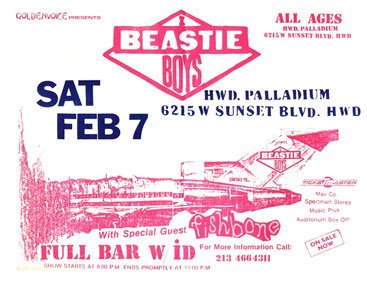
In fact, the Beastie Boys came back to Los Angeles six months later, actually playing the Hollywood Palladium on February 7, 1987. That show was noteworthy for having Run-DMC as special guests and Fishbone as opener. Yeah, I’m sure that was no fun at all. For those of you into bootlegs of historically relevant events, check out this sweet download from It Takes A Nation Of Millions To Hold This Sac.
On that note, let’s finish up with classic video footage from 1987 of the Beasties and Run-DMC on CBS News Nightwatch. Here they discuss media representations of hip hop culture in the wake of the Long Beach riot. Beyond that, there is pure gold all up in this clip. Mike D choosing to appear on TV in shorts, Mike D doing the Jerry Lewis (7:55), an off-the-cuff version of “My Adidas” (8:29), and I believe MCA off-camera referring to the Beasties’ songwriting technique as a “bouillabaisse” (9:14), three years before they’d conclude Paul’s Boutique with a medley bearing that moniker.
Incidentally, Power Tools closed on April 4, 1987, eight months after the Beasties' set that barely was, and probably around the time this CBS segment was filmed. It wasn't legal hassles or pending bankruptcy or anything remotely nefarious. When asked by the LA Times why he was shuttering the successful club, Jon Sidel said, "We're bored and want to get on to something new. The club isn't what it once was. We started playing a certain kind of music and now everyone's started doing they're own version of it, so it's on to something else." Added partner, Matt Dike, "We're also burnt out. We felt we did everything we had to do."
Within a year's time, the Beastie Boys would have similar feelings about being the Beastie Boys.
Bob is now semi-famous as the drug dependency counselor (with the hat) on Celebrity Rehab and the subject of Keirda Bahruth’s documentary, Bob And The Monster. In 1986, he was semi-famous (in Los Angeles) as both scenester and lead singer of Thelonious Monster, whose debut album I should note also came out in 1986. Obviously, Baby, You're Bummin' My Life Out In A Supreme Fashion was a blip on the cultural radar compared to Licensed To Ill, but in the special confines of the Adios Lounge, the Monster and the Beasties more or less carry equal weight. (Incidentally, both bands sound like homages to Maurice Sendak, author of Where The Wild Things Are, who passed away four days after Yauch.)
In an interesting sub-twist, Bob recently discussed this fateful night on his awesome internet radio show, All Up In The Interweb. It was the first show following Yauch’s death, so Bob played “Sabotage,” and then followed up with both story and song. Yes, you are about to be privy to a document long since thought lost. Here is the Beastie Boys’ aborted performance from Power Tools, with Bob Forrest on preamble and postamble.
FYI, this sounds like shit because a) It sounded like shit at the time and b) This is probably a 3rd or 4th generation cassette dub. But, it exists, so be thankful.
Bob Forrest + The Beastie Boys
Power Tools, Los Angeles
August 16, 1986
Excerpt from the May 9 broadcast of All Up In The Interweb
Alcohol + frustration + public embarrassment has been known to lead to fisticuffs. Oh well, it was 26 years ago. Bob brings up a valid point, though. When was he going to have experience running sound for a rap show? That’s truly a comical image. I mean, I know it sucked in the moment, but what did Dike expect to happen? He was only yelling at Bob because he could, shit rolleth downhill and whatnot. Of course, no shitty sound, means no Mario Caldato, Jr., and extrapolating from there is a hideous alternate reality from which there’s no escape. So, let’s just admit that everything worked out the way it was supposed to.
On a related note, y'all really should check out Bob’s show, All Up In The Interweb. He rants, raves, plays good music, and tells hilarious stories, which are often indistinguishable from this rants. As a matter of fact, on the show from which the Power Tools story comes, Bob talks about meeting Gibby Haynes of the Butthole Surfers, living in filth with John Frusciante, drying out (not really) on a road trip to Albuquerque, New Mexico, with Peter Case, and an epic story involving David Lee Roth, New Order, and Nile Rodgers, cocaine, and a broken broom closet.
All Up In The Interweb is on Wednesdays, 8-10 pm PST, rebroadcasts Saturday 1-3 pm PST, and within a week or two, the shows are all archived on Bob's website. Frankly, I recommend downloading a few shows (starting with the one linked above), putting them on your phones or ipods, and listen to them when you’re walking around or stuck in traffic.
THERE'S A RIOT GOIN' ON
The twists of this story don’t quite stop with Bob. The other thing rarely addressed in accounts of August 16, 1986, is August 17, 1986. The fact is, the Hollywood Palladium gig mentioned by Ad-Rock (“Y’all come down to the fuckin’ Palladium on Monday”) never happened. The reason why is because on Saturday the Raising Hell tour hit Long Beach … and Long Beach hit back.
While Whodini was warning concertgoers that “The Freaks Come Out At Night,” gang members swept through Long Beach Arena, swinging fists, chains, chair legs, and pretty much anything else that could be used as a weapon. Eventually, 42 people were injured and according to Greg Mack, operations manager and program director for KDAY (1580 AM), “People that were inside couldn’t get out as quickly as I did because they had to go through the regular doors. As you can imagine, there was mass hysteria. It was the last rap concert Long Beach ever had. It was a real sad time for rap, period.”
In fact, the Beastie Boys came back to Los Angeles six months later, actually playing the Hollywood Palladium on February 7, 1987. That show was noteworthy for having Run-DMC as special guests and Fishbone as opener. Yeah, I’m sure that was no fun at all. For those of you into bootlegs of historically relevant events, check out this sweet download from It Takes A Nation Of Millions To Hold This Sac.
On that note, let’s finish up with classic video footage from 1987 of the Beasties and Run-DMC on CBS News Nightwatch. Here they discuss media representations of hip hop culture in the wake of the Long Beach riot. Beyond that, there is pure gold all up in this clip. Mike D choosing to appear on TV in shorts, Mike D doing the Jerry Lewis (7:55), an off-the-cuff version of “My Adidas” (8:29), and I believe MCA off-camera referring to the Beasties’ songwriting technique as a “bouillabaisse” (9:14), three years before they’d conclude Paul’s Boutique with a medley bearing that moniker.
Incidentally, Power Tools closed on April 4, 1987, eight months after the Beasties' set that barely was, and probably around the time this CBS segment was filmed. It wasn't legal hassles or pending bankruptcy or anything remotely nefarious. When asked by the LA Times why he was shuttering the successful club, Jon Sidel said, "We're bored and want to get on to something new. The club isn't what it once was. We started playing a certain kind of music and now everyone's started doing they're own version of it, so it's on to something else." Added partner, Matt Dike, "We're also burnt out. We felt we did everything we had to do."
Within a year's time, the Beastie Boys would have similar feelings about being the Beastie Boys.