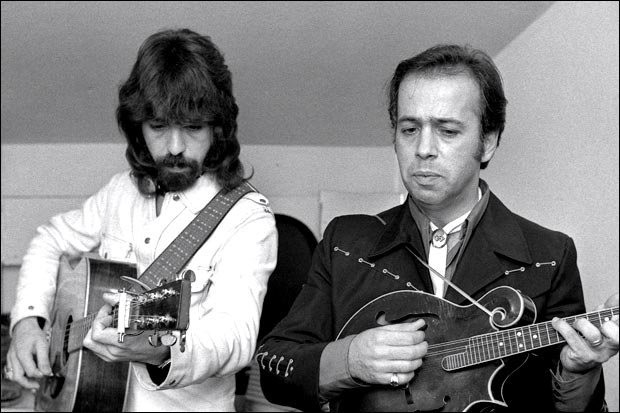
Clarence and Roland White: 1972
Photo: Frank Chino
Photo: Frank Chino
And so we come to the final calendar year of Clarence White's life. I've put this off for as long as I could because I know how it ends: tragically, painfully, and with a myriad of musical possibilities extinguished. His death on July 15 left a huge hole in the development in rock and bluegrass, but the loss to the White family was (and is) immeasurable. The beauty of the first 7 months and 14 days of 1973 wasn't just that he made a decisive step forward as a bandleader and solo artist, it's that he returned to the family business: bluegrass. But, before we know what it means to be lonesome, there was the end of The Byrds to address.
After four years of steady employment, the road Byrds were being phased out by the original Byrds. The road Byrds played a handful of shows in January and February, including a tribute to Earl Scruggs that turned into the film, Banjoman. However, the reunion album featuring Gene Clark, Chris Hillman, David Crosby, Roger McGuinn, and Michael Clarke was released in March and there was no point having gigs if the public expected the original five to show up. Unfortunately, the original Byrds failed to capitalize on the initial wave of enthusiasm for the reunion album. They played not once, leaving both versions of the band dead on the vine, and ignominiously ending the career of one of the most innovative American bands of all-time.
On February 3, The Byrds played the series premiere of The Midnight Special, a show that followed Johnny Carson on Friday nights and lasted until 1981. "So You Want To Be A Rock N' Roll Star" was one of the songs they played. Here's the other, a McGuinn and White acoustic duet.
This song has an interesting history. Shortly after hearing Dylan sing it at the Newport Folk Festival in July 1964, Kentucky Colonels manager, Jim Dickson (RIP), brought a demo of "Mr. Tambourine Man" to Clarence White, in hopes he'd record it with the Colonels. Clarence turned him down, so Dickson took the song to the other band he managed, The Jet Set, who'd soon change their name to The Byrds. Immediately upon its release, "Tambourine Man" became a chiming rock anthem for a generation of proto-hippies and is probably their most recognizable song. In 1968-69, shortly after Clarence joined the band, it turned into a heavy rock jam that, in my opinion, didn't quite work. Then, from 1971-73, it transformed again, into the beautiful acoustic duet between Roger and Clarence you see above. It's a great tune, a great rendition, and as swan songs go, not too shabby. But, what the fuck is with Roger's jacket? It looks like something that should be worn by an animatronic dog carrying a fake pistol.
MULESKINNER
On February 14, not February 13 as the video says above, White hooked up with a few of his rock-friendly bluegrass friends: Richard Greene (fiddle), David Grisman (mandolin), Bill Keith (banjo), and Peter Rowan (guitar, vocals). They were scheduled to perform on public television backing Bill Monroe. This was not an accidental collaboration since Greene, Keith, and Rowan were Blue Grass Boys in the 1960s, as was Clarence's brother, Roland, who we will meet again shortly. The video clip, great as it is, actually omits 4 songs, which were later released on CD.
Peter Rowan explains the origin of Muleskinner: "Some few months after Richard Greene and I had left Seatrain, Clarence White had left The Byrds, Bill Keith had left Kweskin's Jug Band, David Grisman had left Earth Opera and just produced the first Rowan Brothers album, Richard invited us all to play on KCET television in Los Angeles with Bill Monroe and his Blue Grass Boys as a sort of 'Father of Bluegrass and his Sons' show. Well, Bill's bus broke down in Stockton, California, and we had to do the show on our own."
1. New Camptown Races 0:22-2:07
2. Dark Hollow 2:14-4:45
-Clarence harmony vocal with Peter Rowan
-Clarence solo 3:55-4:13. Funky, bluesy, behind the beat, like Chuck Berry meets bluegrass.
3. Land Of The Navajo 5:11-10:50
-Clarence solo 8:26-8:51. Toying with the beat.
4. Blackberry Blossom 10:57-13:26
5. Knockin' On Your Door 13:37-16:39
-Clarence solo 15:39-15:57
6. Opus 57 In G Minor 16:47-18:47
7. Red Rocking Chair 18:55-22:20
-Clarence solo 20:54-21:09
8. The Dead March 22:22-24:59
9. Orange Blossom Special 25:05-25:58 (cut)
I'm obviously partial to Clarence, but all of these guys were heavyweights in bluegrass and folk music. And as you can imagine, the fan response to watching Muleskinner kick grassy ass was, "More please." So, they hit the studio between March 27-April 14, during which time they also played a few shows at the Ash Grove in Hollywood. Sadly, and in what is obviously this chapter's central motif, the death of Clarence meant the end of Muleskinner, a supergroup who existed for a shockingly brief 9 weeks.
Muleskinner - Mule Skinner Blues [buy]
 "(Clarence) brought a lot of black blues guitar playing to white acoustic bluegrass guitar, which set him apart from other players. And I have not heard anyone play electric guitar like Clarence. I remember him playing stuff in the bass register of electric guitar that I had never heard before. It was very funky, very rocky."
--Richard Greene to Rick Petreysik, "Echoes of a Country Rock Legend," Guitar Player, September 1992, page 84
I love that Muleskinner kicks off their debut album with a bluegrass-rock hybrid that probably wouldn't have worked in anyone else's hands circa '73. Granted, it helps when you have White channeling James Burton, Greene on slash-and-burn violin, and Rowan with the sweet yodel. John Guerin actually replaced Gene Parsons as The Byrds' drummer in late '72, so Clarence undoubtedly felt comfortable with him behind the kit.
And while it's a subtle association, CW's famous B-Bender (panned left throughout "Mule Skinner") was also retrofitted with banjo tuners on the high and low E strings, so he could quickly switch tunings. Those tuners were invented by a pair of college buddies who were also banjo enthusiasts: Dan Bump and Muleskinner's own Bill Keith. 38 years later, the Keith tuner remains the industry standard.
Muleskinner - I'm Blue, I'm Lonesome [buy]
same lineup
This old Bill Monroe gem features great country picking from White, a tight mandolin solo from Grisman, Keith switching gears on pedal steel, and more Greene brilliance. However, the real showcase just might be the wonderful harmonies between White ("When I hear that whistle blow") and Rowan ("I want to pack my suitcase and go-o-o!").
DON'T GIVE UP YOUR DAY JOB
Before we get to Clarence's familial repatriation, let's remember that he was still a studio musician in high demand. Here are my three favorite examples of his session work in 1973.
Gene Parsons - Banjo Dog [buy]
When Gene Parsons left The Byrds, he began recording his debut solo album, Kindling. "Banjo Dog" features Parsons on the titular instrument and his old buddy, CW, on acoustic guitar and a semi-rare appearance on mandolin. Maybe it's just me, but I think White has a riff here that directly anticipates Jay Bennett's riff in "Hesitating Beauty," one of the highlights on the 1998 Wilco/Billy Bragg album, Mermaid Avenue, which features their interpretation of Woody Guthrie songs.
Arlo Guthrie - Gates Of Eden [buy]
Arlo Guthrie - vocals, guitar
Clarence White - electric guitars
Ry Cooder - bottleneck guitar
John Pilla - bass, co-producer
Did someone say Guthrie? This was Clarence's 4th consecutive appearance on an Arlo Guthrie album, and he and Cooder bounce a few different guitar tracks off one another, while Pilla weaves deft basslines in between. "Gates," of course, was one of Bob Dylan's signature songs from Bringing It All Back Home, the 1965 album that also included "Mr. Tambourine Man." Bob's songwriting hero, of course, was Arlo's dad, Woody, so this might be a good time for y'all to break out your venn diagrams.
Country Gazette - Huckleberry Hornpipe [buy]
Clarence White - lead acoustic guitar
Kenny Wertz - guitar
Herb Pedersen - guitar
Byron Berline - fiddle
Alan Munde - banjo
Roger Bush - bass
Like Muleskinner, Country Gazette was a bluegrass supergroup featuring some of prog-grass' finest exponents, including Clarence's former bandmate in the Colonels, Roger Bush. "Huckleberry" is the leadoff track from 1973's Don't Give Up Your Day Job, and though it was written by Berline, White's double-tracked solo from 1:32-2:17 is the clear highlight and breathtaking in its virtuosity.
On April 7, more or less concurrent with his Muleskinner and Country Gazette gigs, Clarence played the televised Bob Baxter Guitar Workshop with brother Roland on mandolin, Byron Berline on fiddle, and Alan Munde on banjo. The ensemble, including Baxter, works through a pair of old-timey numbers that were a regular part of the Kentucky Colonels' sets in the 1960s. The appearance of Roland, however, is worth exploring further.
O BROTHER, WHERE ART THOU?
 "Clarence called me in early '73 when I was still with Lester Flatt and told me he was out of The Byrds. He said Eddie Tickner, who was the manager for The Byrds, was going to manage him, and he had quite a few places in Europe he could put us. Clarence asked me if I was interested and how the job was going with Lester. I said, 'OK, but it's been about 4 years.' (He said) we could go to Europe, get Eric (brother Eric White) and Herb Pederson to do it. I said, 'All it takes is you telling me we're doing it and I'll turn in my notice.' Four years is a good amount of time and I really wanted to play with Clarence. And it happened. I went out to California, we played a couple of little shows, one at the Ash Grove, then we went to Europe."
--Roland White to Bob Moses, SmokeMusic.com, 2010
For those of you who are timeline nerds like me, Roland started playing mandolin with Lester Flatt and the Nashville Grass in early 1969, just after the dissolution of Flatt & Scruggs. Previous to that, Roland was Bill Monroe's guitarist from May 1967 to February 1969. In fact, White was a Blue Grass Boy simultaneous with Byron Berline. So, the Baxter show was one of the first gigs the White brothers (as well as Berline) played together, but it wasn't long before they were off and running, writing a new (albeit brief) chapter in their careers.
EASTER AT THE ASH GROVE
White Brothers (New Kentucky Colonels) - Shuckin' The Corn
White Brothers (New Kentucky Colonels) - Good Woman's Love
Clarence White - guitar
Roland White - mandolin
Roger Bush - bass
Byron Berline - fiddle
Herb Pedersen - banjo, guitar (?)
Alan Munde - banjo, guitar (?)
John Hartford - fiddle*
Brantley Kearns - fiddle*
Steve Mandel - guitar*
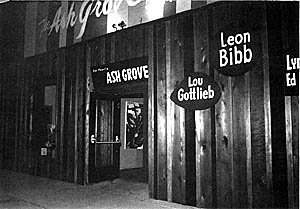 I'm not 100% sure when this gig went down, but all the available evidence points to a White Brothers (aka New Kentucky Colonels) gig at the Ash Grove on Easter Sunday. Roland notes the "one gig" above, but I've also read that the group held down a week-long residency at the Grove between April 15-22. So, it's possible that this show is a compilation of tracks from that week. Also, so many friends sat in ... including Muleskinner, who'd just finished recording ... that it probably felt like open mic night for the elite of west coast bluegrass. The lineup above features the various musicians known to have played, with the * representing maybes.
As for the set, the band is loose and clearly having a great time. Then, Clarence takes things to another level. When his solo drops on "Shuckin'" (1:12-1:30), you can hear the crowd gasp and whoop, and I swear the other players drop out as if they were too busy watching him to remember to play. Bush totally calls it when he remarks, "Lightning fingers."
But, therein lies the CW genius. "Good Woman's Love" works, not because he goes 100 MPH, but because his guitar playing supports (and extends) the melody and distinctive White vocal harmonies. It's slo-mo Django that recalls something Gene Parsons once said: "Clarence's one guideline was to play the least amount of notes with the most amount of impact." Word.
THE WHITE BROTHERS IN EUROPE
White Brothers (New Kentucky Colonels) - New River Train
White Brothers (New Kentucky Colonels) - I Know What It Means To Be Lonesome
White Brothers (New Kentucky Colonels) - Rawhide
White Brothers (New Kentucky Colonels) - You Won't Be Satisfied That Way
White Brothers (New Kentucky Colonels) - Sally Goodin (guitar solo)
Clarence White - guitar, vocals
Roland White - mandolin, vocals
Eric White - bass
Alan Munde - banjo, vocals
"We really felt good about it from the beginning, especially between Clarence, Eric, and I. We could really work together and Al was musician enough to get right in there and do it. Clarence was surprised because he really enjoyed playing the bluegrass. I think it was a challenge to him because he didn't think he could do it again. It was just the best time I had playing music ever. That was it, period, right there."
--Roland White, from the Live In Sweden liner notes
If you're even remotely bluegrass-curious, you need to track down a copy of Live In Sweden (pictured left). In fact, ask nicely and I may post it here. It's seriously one of the best bluegrass shows I've ever heard and it actually came about by accident. The Dillards were booked to play England, Holland and Sweden, but when they dropped out at the last minute, the White Brothers/New Kentucky Colonels filled in at the behest of Eddie Tickner, Clarence's manager. The European tour essentially functioned as a showcase for Clarence, who was bandleader, co-lead singer, and guitar god.
CW's leadership aside, what's remarkable about the Sweden recording is the symbiosis between Clarence and Roland. Where Muleskinner showed how a dream team of bluegrass talent can bring out the best out in each other, Live In Sweden showed that blood is thicker and more harmonious than even the dreamiest, teamiest water. While not close harmony singers in the tradition of the Louvins, the Clarence/Roland vocal blend nevertheless elevates the singing well beyond their individual talents. A similar intuition pervades their guitar/mandolin interplay, which sounds like two brothers finishing each other's thoughts. Herein lies the core tragedy of Clarence's death. It didn't just rob us of his many talents, but robbed us of future Clarence/Roland magic. Sweden is a small, glorious window into that never-to-be-realized future.
THAT CROSSOVER SOUND
The Colonels returned from Europe in late May, with Munde going back to Country Gazette. Meanwhile, the White Brothers played the Indian Springs, Maryland, Bluegrass Festival on June 2, billed as the New Kentucky Colonels. Clarence, Roland, and Eric manned their usual battle stations with Jack Hicks (Bill Monroe's band) on banjo and John Kaparakis on rhythm guitar (pictured below).
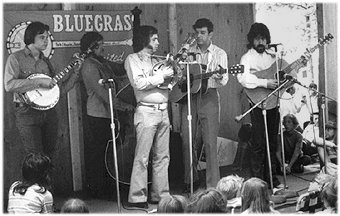 Kaparakis explains: "Clarence had never played at a bluegrass festival before Indian Springs and he knew that many people in that audience would be listening for him to play lead guitar as only he could play it. For that reason, so Clarence could concentrate on playing lead guitar, the New Kentucky Colonels asked me to join them on stage that weekend and play rhythm guitar. Clarence was very much impressed and touched by the crowd response. The audience just LOVED him and their music. Many musicians before and since Clarence White have been searching for that 'crossover' sound, a new type of music which will appeal equally to audiences in the bluegrass, folk, and country markets. No one has yet found it. Clarence White would have been the first ... had he lived."
YOU'RE NOT THE ONLY FUCKING STAR AROUND HERE!
Now for my favorite Clarence White story of all-time, bar none. I'm a bit disappointed that in 38 years an exact date hasn't been established, but given that the White Bros played Indian Springs, MD, on June 2, this must've taken place the following weekend (June 8-9, 1973). Whatever the date, I'm pretty sure this will make me laugh when I'm 140 years old and living on cryogenic smoothies. And since there's no way I can improve upon Ben Fong-Torres' version, here's the excerpt from his excellent Gram Parsons bio, Hickory Wind.
Gram and Emmylou (Harris) were preparing for a trial, three-date tour set up by Warner Bros. Records. The idea was to have a caravan of country acts -- Country Gazette, the Kentucky Colonels, and Gram and Emmylou. Gene Parsons, by now a solo artist on Warner, along with Chris Ethridge and Sneaky Pete (Kleinow), completed what the label billed as a traveling "country rock festival."
With so much talent on board, the stage was bound to be overcrowded, and at one of the shows -- the one in Annapolis, Maryland -- it was. It was the electric set, the highlight of a day-long show. It was after midnight when Gene, Chris, and Sneaky Pete, joined by Clarence White, climbed onto the stage with Gram and Emmylou.
As Gene recalled it, the song had reached the place where White would take his solo break. Clarence was considered by his peers the best country guitar player going and he was not a great admirer of Gram. The word was that he'd been considered for The Byrds in 1968 when Gram got the job.
Now here was Gram playing to the crowd by motioning for Clarence to turn down his volume. If Gram was no longer sashaying like Mick Jagger, he was still putting on superstar airs. Soon, he was motioning for the whole band to turn it down, even confiscating Gene's drumsticks, leaving him to play with his hands.
When Clarence stopped playing his solo, Gram didn't appear to notice. All he knew was that the crowd seemed to enjoy his antics. Clarence picked up again and finished his solo and the electric set ended. But the show continued backstage.
Clarence, who was almost a foot shorter than Gram, grabbed him by the neck, pulled him off to one side, and shouted: "Listen, you son of a bitch, I've played more country music than you've ever played and I know more about it than you'll ever know! Just remember: You're not the only fucking star around here!"
Gram talked back, but without much energy or conviction. It was nearly three in the morning and through a haze of drink and drugs, Gram managed to understand that he had been out of line. His southern manners came back and he managed an apology. "I didn't mean to offend," he said.
Clarence accepted the apology and they became close friends for the few days remaining on the tour.
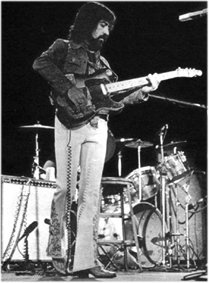 If you didn't love Clarence before, how could you not love the little guy now? Come on, getting up in GP's grill and knocking him down to size?!?! The stuff of which legends are made. And that whole part about playing and knowing more about country music than Gram? I call those kinds of assertions "facts." The caravan played only one more show, the following night at the Tower Theater in Philadelphia* (pictured left), which proved to be Gram's last public performance.
*Technically, the Tower is in Upper Darby, not Philly, but no one knows where that is outside of Tina Fey, who grew up there. So, Philly it is.
SOLO ALBUM
Clarence White - Never Ending Love [buy]
Clarence White - Alabama Jubilee [buy]
Clarence White - Why You Been Gone So Long?* [buy]
Clarence White: electric and acoustic guitar, lead vocals
Roland White: mandolin, vocals
Herb Pedersen: rhythm guitar, vocals
*Ry Cooder: slide guitar
Byron Berline: fiddle
Lee Sklar: electric bass
Roger Bush: standup bass
Ed Green: drums
 On June 28-29, Clarence went into the studio with the late Jim Dickson to begin work on his first solo album. Judging by the tracks that were eventually released on Silver Meteor, the tracklist was more or less composed of songs in the White Brothers' setlist at the time. The one thing that jumps out, not just here, but throughout 1973, is Clarence's vocal confidence. "Bugler" was the first sign that he'd grown comfortable with his voice, but here he almost sounds like a genuine frontman. The only thing missing from these tracks are bona fide electric guitar leads, which Clarence never had the chance to overdub.
Incidentally, these are rips from the original 1980 release of the Silver Meteor comp, which I lucked into a couple decades ago. They've since been remastered and reissued on Sierra, so click on the "Buy" link above to get the 21st century mojo.
JULY 14-15
"We all want to forget something, so we tell stories. It's easier that way."
--Rashomon, 1950
On the evening of Saturday, July 14, the White brothers had dinner with their mother in Lancaster before heading out to play at BJ's in Palmdale about 10 miles away. Eric was the bass player in a local country band and Clarence, Roland, and Gib Guilbeau, CW's former bandmate in The Reasons (aka Nashville West) all sat in. The band ended sometime after midnight and probably around 1:00 am, the Whites were loading their gear into their car. To this point, it was a fairly typical and uneventful Saturday.
Meanwhile, a few blocks away, a woman named Yoko Ito was being thrown out of the Jack Of Diamonds for being a disheveled, drunken waste of maggot DNA. Ito (who was also allegedly pregnant at the time) got in her car, tore ass down Palmdale's main drag, jumped a curb, and slammed into Clarence, who was launched into Roland. Both men crumpled to the pavement, with Roland suffering a dislocated arm. Clarence, who was thrown about 20-30 feet, went into an immediate coma and died the next day. He was 29 years old.
Now, I don't know if this is true or not, but according to "Califiddler" on the Clarence White Forum, Ito only received a one-year suspended sentence (!!!) and had her driver's license taken away. Are you fucking kidding me?!?! Thanks a lot, 1973 values. Did you get her an ice pack, too, when you slapped her on the wrist? Clarence left behind a wife, two kids, four siblings, both parents, and a legion of brokenhearted friends and fans, including me. Y'all can be philosophical on your own time. I hope Ito is being dipped in lava on the 36th level of hell while getting her face chewed off by Hitler's dog.
THE LAST THING ON MY MIND
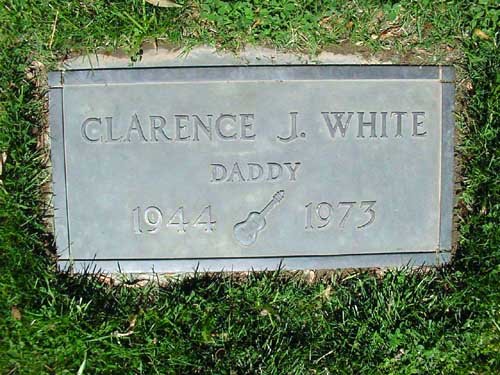
Clarence's funeral was held on Thursday, July 19, at a Catholic church in Palmdale, but he was buried at Joshua Memorial Park in Lancaster. According to Bernie Leadon, former Burrito Brother and founding Eagle, "After the priest did his formal stuff (at the graveside service) there was this very uncomfortably long silence. I thought there had to be something musical. I was standing next to Gram and I started humming 'Farther Along.' Gram picked up on it and then he and I sang a verse and a chorus in very shaky voices. No one else joined in. After we finished, the crowd dispersed and Roland came over to express his gratitude that we did that." (John Einarson, Hot Burritos: The True Story Of The Flying Burrito Brothers, p. 310-11)
Byrds - Farther Along [buy]
Clarence's funeral was noteworthy for two simultaneous events. It was there that Roger Bush asked Roland to join Country Gazette, as much to replace the departing Kenny Wertz as to keep him occupied through his grief. Roland would spend the next 13 years in the Gazette, his own personal Fort Recovery.
Meanwhile, Gram was so depressed by Clarence's death he (in)famously told his "road mangler" and confidant, Phil Kaufman, "Phil, if this happens to me, I don't want them doing this to me. You can take me out to the desert and burn me. I want to go out in a cloud of smoke." Two months later, Phil did just that, kidnapping Gram's coffin from LAX and burning it in Joshua Tree National Park. GP was 26 years old.
I'm giving the final word to not just Clarence, but the entirety of the White family. This is a wonderfully bittersweet video, but the love is tangible. And to Clarence, wherever you are in heaven, I hope I did your story justice. You are missed, brother.
"Dry your eyes and stand up straight
Bugler's got a place at the Pearly Gates
Say goodbye sugar, oh say goodbye."
Download full playlist as zip file (16 songs, 45:09, 69 MB)