
| Safe and secure from all alarms ... even Robert Mitchum |
.
"Leaning On The Everlasting Arms" is a hymn written in the late 19th century, not markedly different in structure or tone from a thousand other hymns and spirituals of the era. Composed by Anthony Showalter and Elisha Hoffman, "Leaning" was inspired by Deuteronomy 33:27, "The eternal God is thy refuge and underneath are the everlasting arms." If you're gonna write a hymn, that's probably a good place to start. However, the song occupies a unique place in American culture, not because of its inherent musicality, but because it's been a powerful narrative device in three separate films, each of which reflects the American experience.
1943 was one of the shittier years in US history. Knee deep in the war effort, we ate dirt for breakfast, weeds for dinner, and contented ourselves with Frank Sinatra, Betty Grable, and World War II movies. One of those movies was The Human Comedy, a homefront drama starring Mickey Rooney that filled you full of homilies and song, gave you a small measure of hope, and is palatable in 2012 for maybe 10 minutes. Pure, uncut sentimentality, not much going on in the plot, it was clearly created to distract 1943 for two hours, 2012 sensibilities can eat shit. Narrative limitations notwithstanding, one of the better scenes was when a train full of GIs bound for the Pacific began singing an old hymn.
The Human Comedy, 1943
Director: Clarence Brown
This is reminiscent of the scene in Casablanca were Victor Lazslo leads the band through "La Marseillaise." Obviously, with the one character here breaking the fourth wall and looking directly into the camera, the expectation was to lead the movie audience in the singalong. Remember, it was 1943 and Americans didn't need any fucking gray area or moral quandary. There would be plenty of time for that after the war. Our movies contained rousing anthems because that's what we needed. Life was black and white and at stake was Allied vs Axis, good vs evil, love vs hate, and there were no guarantees that the good guys would win.
The difference between the two songs is how they relate to identity. "La Marseillaise" is the French national anthem, so for Americans watching Casablanca it's obviously meant to convey sympathy for a war ally. "Leaning On The Everlasting Arms" works on a different level. Sure, it's an American hymn in a war movie, so it can't help but be political to some degree. But, a hymn is an expression of spirituality and being connected to "something we all know and used to sing as kids." For Americans about to enter a war they might not win -- and even if they win, might not come back alive -- it took more than "God Bless America" and "Yankee Doodle Dandy" to give us strength. If there were no atheists in WWII foxholes, it's probably because they were singing this song.
Spoiler Alert: The good guys won World War II. And with Allied victory came postwar surplus, as well as its twisted American counterpart, postwar malaise. In 1955, one movie reflected this creepy duality through its own appropriation of "Leaning On The Everlasting Arms," The Night Of The Hunter. As it turns out, there's a direct connection between Hunter and The Human Comedy: Robert Mitchum, who appeared uncredited in Clarence Brown's wartime drama.
That's Mitchum to the far left.
Please note two things. 1) The girl in the dark dress is Donna Reed, three years before she co-starred in It's A Wonderful Life, and 2) It's Mitchum who begins singing the Roy Rogers song, "Git Along Little Dogies," at the end of this scene. This would normally be a forgettable throwaway element, were it not for his singing twelve years hence.
Oh, and it's some singing ...
Robert Mitchum and Lillian Gish
The Night Of The Hunter, 1955
Director: Charles Laughton
The Night Of The Hunter is a brilliant American phantasmagoria, despite the fact Laughton was British, and his film was visually influenced by German expressionism. If WWII movies conveyed the simplistic idea that America and democracy were good and Hitler and fascism were bad, the best postwar movies revealed that evil is not only here in America, it may be superficially indistinguishable from good. In fact, the scariest possibility of all is that good AND evil -- or love and hate, if you prefer -- are inside all of us. To wit:
 |
| "Those fingers, dear hearts, is always a-warring and a-tugging, one agin t'other." |
Laughton's genius was recontextualizing "Leaning On The Everlasting Arms" to reflect this duality. For Mitchum's character, "Reverend" Harry Powell, the hymn was a sociopath's siren song, used to prey on (pray on?) the gullibility and childish naivete of adults. As the titular hunter, he is hate personified. Lillian Gish's character, Rachel Cooper reclaims "Leaning" with the fierce determination of true faith. She is love personified. As she declares earlier in the movie, she is "a strong tree with branches for many birds." Oh, and one of her branches is a shotgun, so there's that.
If "Leaning" is "something we all know and used to sing as kids," then it stands to reason that some kids grow into good adults, others grow into bad adults, and there's probably more overlap than we care to admit. Hymns belong to everybody. In fact, sometimes hymns belong to kids.
What have I to dread? What have I to fear?
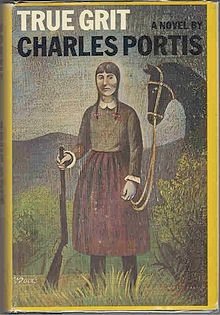 What music should accompany a 14-year-old girl bent on avenging her father's murder in the Old West? "I thought that hymns, or music that sounded like hymns, would remind you that what's driving the whole story is a biblical sense of righteousness," says composer Carter Burwell of "True Grit." (Variety, Dec 15, 2010)
If The Night Of The Hunter reflected the America of 1955, the same could be said of True Grit in 2010. For one thing, what could be more 21st century than recycling a previously successful idea? Thankfully, it was the Coen Brothers doing the recycling, so what could've been a quick and dirty cash grab was instead a heartfelt reprisal of a great story. In fact, I argue that True Grit 2010 was less a remake of True Grit 1969, than it was the first proper adaptation of Charles Portis' 1968 novel.
The original True Grit was an homage to John Wayne, Portis' novel was merely a convenient reference point. The Coens adhere to the book's narrative, focusing on Mattie Ross, the tenacious, 14-year-old girl whose father is killed. Like any good daughter, she invoked Old Testament-style vengeance when playing ball didn't work. Unfortunately, Mattie learned the hard way about going Biblical. She lost her arm and killed her horse and her father wasn't any less dead. When she says, "You pay for everything in this world. There is nothing free, except the grace of God," it's with the understanding that the grace was simply not dying. Also, with the Coens not being dummies, I can't help but feel the song title is an ironic commentary on Mattie's condition. Not mocking nor rebuking, so much as reminding her that "Vengeance is mine; I will repay, saith the Lord." (Romans 12:19)
FYI: This video is a bit louder than the others. Prepare accordingly.
Iris DeMent, "Leaning On The Everlasting Arms"
True Grit, 2010
Directors: Joel & Ethan Coen
Of the four movies mentioned thus far, three of them share a unique characteristic. Both True Grits and The Night Of The Hunter are all homages to an earlier era of Hollywood. If True Grit 1969 was an homage to John Wayne, True Grit 2010 was an homage to the western itself. In fact, you can make a strong argument that True Grit 1969 was the first meta-western and every western since has also been a tribute to the genre. Meanwhile, The Night Of The Hunter was Charles Laughton's homage to D.W. Griffith and the silent era of Hollywood, including actual Lillian Gish, star of Griffith classics, The Birth Of A Nation and Intolerance.
What a blessedness, what a peace is mine
I now leave you with bonus "Leaning." Two weeks ago today, Andy Griffith died of a heart attack at his home in North Carolina. For those of you keeping score, that's three prominent NC musicians to die in less than 100 days: Earl Scruggs (March 28), Doc Watson (May 29), and Griffith (July 3). Granted, these fellas were all in their mid-to-late 80s, but we might wanna keep an eye on the members of Superchunk just in case.
This clip comes from either a 1963-64 episode of The Andy Griffith Show featuring Andy and The Darlings singing a verse and the refrain of "Leaning On The Everlasting Arms." The Darlings were actually The Dillards, a pioneering bluegrass band in early '60s Los Angeles, featuring Rodney Dillard on guitar, dobro, and vocals and Doug Dillard on banjo and vocals. Sadly, Doug died this past May 16 from complications due to a collapsed lung, preceding Andy in death by only 49 days. It is to their memory that this song is dedicated.
Doug is between Rodney on guitar and Denver Pyle on handlebar 'stache
What have I to dread, what have I to fear
Leaning on the everlasting arms
I have blessed peace with my Lord so near
Leaning on the everlasting arms
Leaning, leaning, safe and secure from all alarms
Leaning, leaning, leaning on the everlasting arms








No comments:
Post a Comment